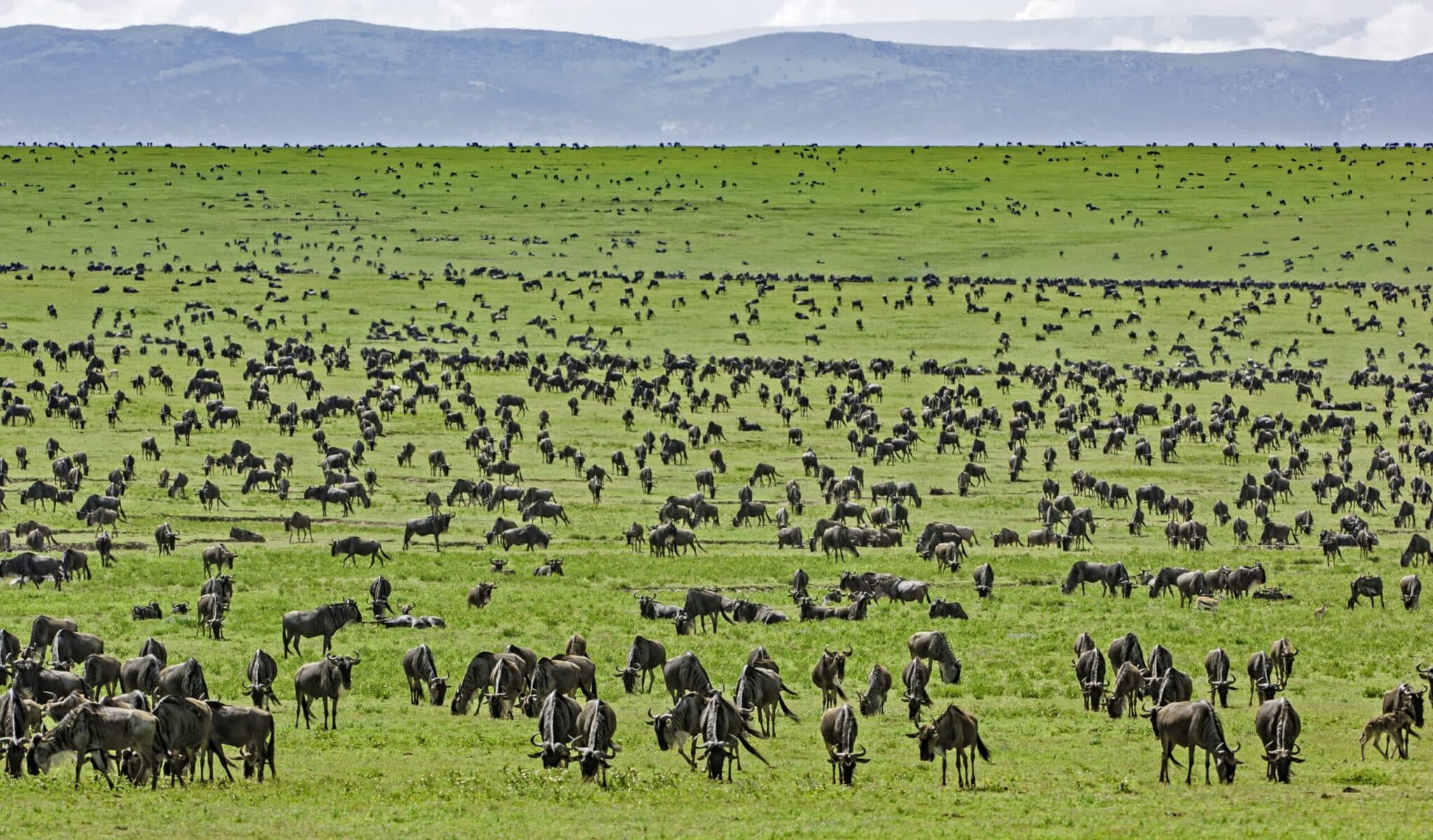
Experience the most incredible natural event in the world.


If you are looking for one of the most picturesque images of the Great Wildebeest Migration, you’re looking in the right spot.


While seeing literally millions of wildebeest make their lumbering way across Eastern Africa may seem like it isn’t a tough task to accomplish, Serengeti National Park is one of the largest national parks in the world, with incredibly vast plains.
There are dozens of accommodation options for witnessing the Great Migration. Please contact us.

Following the Great Migration can be tough work, and if you’re one of those people who prefers to travel in comfort, we’ve got you covered.


We curate those kinds of trips all the time and are more than happy to help customize your perfect safari package that includes the Great Migration.

Where’s the most popular place to spot the Migration? Right here!
Need some more information about the Great Migration? We’re here to help!
Explore our FAQs below.
The Wildebeest Migration Safari is a type of wildlife safari that focuses on witnessing the annual migration of wildebeest and other animals across the Serengeti Plains in Tanzania and the Masai Mara in Kenya. It’s one of the most spectacular natural events in the world and draws thousands of visitors each year.
The best time to go on a Wildebeest Migration Safari depends on the location and stage of the migration. In Tanzania, migration usually occurs between December and August, while in Kenya, it occurs between September and October. The best time to see the wildebeest crossing the Mara River is between July and October. However, to get a better idea of what you can expect and when, check out our Great Migration Guide.
On a Wildebeest Migration Safari, you can expect to see a wide variety of wildlife, including wildebeest, zebras, gazelles, elephants, lions, leopards, and cheetahs. The migration also attracts a large number of bird species.
Accommodation on a Wildebeest Migration Safari can vary depending on the tour package and budget. Some program include luxury lodges or tented camps, while others programs include more budget-friendly options such as camping.
To choose a Wildebeest Migration Safari, it’s important to do your research and read reviews from previous travelers. Look for tour operators with a strong reputation for customer service, knowledgeable guides, and ethical and sustainable tourism practices.
The typical duration of a Wildebeest Migration Safari can vary depending on the tour package and activities included. Easy Travel offers packages ranging from 5 to 10 days, with some longer packages available for those looking for a more comprehensive experience.
The weather on a Wildebeest Migration Safari can vary depending on the location and time of year. Generally, Tanzania and Kenya experience a dry season from June to October and a rainy season from November to May. During the dry season, temperatures can be hot during the day but cool down at night, while the rainy season can be more humid and wet.
Most accommodation on Wildebeest Migration Safari offer a variety of cuisine, including traditional African dishes and international options. Many also offer vegetarian and special dietary options upon request.
The cost of a Wildebeest Migration Safari can vary depending on the tour package, level of accommodation, and activities included. Budget-friendly packages can start at around $1,500 per person, while more luxury options can cost upwards of $3,000 or more. Feel free to explore some of our Great Migration safari packages or talk to one of our travel planners to get a better idea of pricing.
Yes, we offer family-friendly Wildebeest Migration Safari suitable for children. However, it’s important to check with our safari experts beforehand to ensure that the tour is age-appropriate and that children can participate in the activities.
Tipping is common on Wildebeest Migration Safari, and it’s customary to tip your guides, drivers, and camp staff. The tip can vary depending on the level of service and your satisfaction, but a general guideline is to tip around $25 per day per couple for driver guides and around $15 per day for camp staff.
Yes, the Wildebeest Migration crosses over both Tanzania and Kenya, so it’s possible to witness it from both countries. Depending on when you arrive in Tanzania, you can see the Migratory Herd in Ndutu, Northern Serengeti, Central Serengeti, and Western Serengeti.
Yes, it’s possible to see the Big Five (lions, leopard, elephants, buffalo, and rhino) on a Wildebeest Migration Safari, along with many other wildlife species.
While a Wildebeest Migration Safari focuses on witnessing the annual migration of wildebeest and other animals, a regular safari may offer a more general wildlife viewing experience. A Wildebeest Migration Safari is typically timed to coincide with the migration and may involve different activities and locations than a regular safari.
Easy Travel offer packages combining a Wildebeest Migration Safari with a beach holiday in Zanzibar or elsewhere. This allows travelers to experience both the excitement of the migration and the relaxation of a beach holiday.
While we have nothing but respect for Kenya’s Masai Mara, the Great Wildebeest Migration spends much more time in Serengeti National Park, and the two main river crossings (Mara and Grumeti) take place in Serengeti. In addition, Serengeti is an incredibly large national park with much more to see besides the migration.
We love experiencing the Great Migration in Serengeti National Park and Ndutu, Ngorongoro Conservation Area, as these are some of the most iconic and picturesque parts of Tanzania to see the Great Migration pass through.
The Great Wildebeest Migration is an awe-inspiring natural phenomenon that takes place in
the Serengeti ecosystem, mainly in Tanzania and Kenya. The migration is a constant cycle
where vast herds of wildebeest, accompanied by zebras and gazelles, move in search of
fresh grazing and water. While the precise dates may vary from year to year, we can provide
you with a general overview of the migration throughout each month:
Wildebeest Migration in January
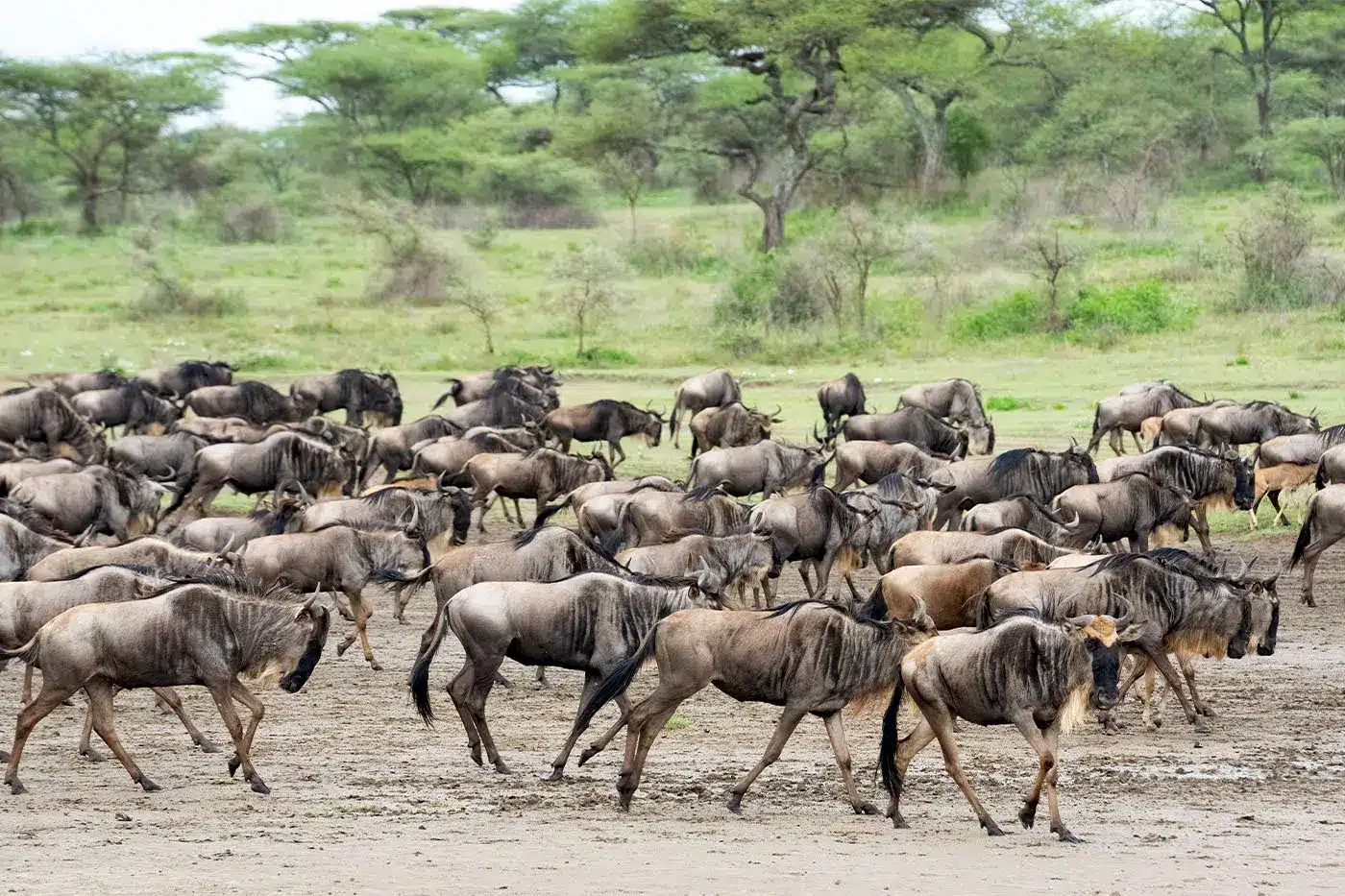
January is a relatively calm part of the year for the Migratory Herd, remaining mostly stationary in Ndutu. This time of year is known as ‘calving season’ which will see nearly 400,000 new wildebeest born to the Migratory Herd. With calving season, however, you are much more likely to see wild cats like cheetah, lion, and leopard, try to pick off the babies of the herd.
Wildebeest Migration in February
February has seen the herd remain mostly stationary for a few months, as the wildebeest feast on the lush, plentiful grassy plains of Ndutu. During February, nearly 8000 new calves are born each day, marking the peak of calving season for the migration. Naturally, the prevalence of young and naïve wildebeest calves means that predatory cats are lurking nearby…
The traditional beginning of the migration will take often place in March. The lush grasslands that sustained the herd will have all but dried up, meaning that the migration will need to start! Slowly taking place over several days, the migration will begin wending its way out of Ndutu, a seemingly unending movement of wildebeest out of their traditional calving region in search of food, water, and safety.
In April, the herd is well and truly on the move. Rainy season has begun in portions of Serengeti, meaning that these great plains will soon be teeming with verdant grass for the migration to feast on. April is commonly known as the wettest month in Tanzania, and the herd will have no shortage of food. It also means that the jungles and plains of Tanzania will be bursting with bird life, a bonus for your Great Migration Safari!
May is known as the tail-end of the wet season, and though the migration has more than enough food to sustain itself, the dry season is coming on soon. May is also a unique time to keep an eye on the herd, as it is the most common time of year to see challenges and battles between alpha male wildebeests, each jostling for a place in the hierarchy of the migration before they move on.
The dry season has finally come upon the Great Migration, meaning that they will have to move on from the relative safety of their Serengeti base from April and May. Even when dry, one of the main sources of water in the Central Serengeti remains the Grumeti River, which the herd will skirt in its millions over the next two months.
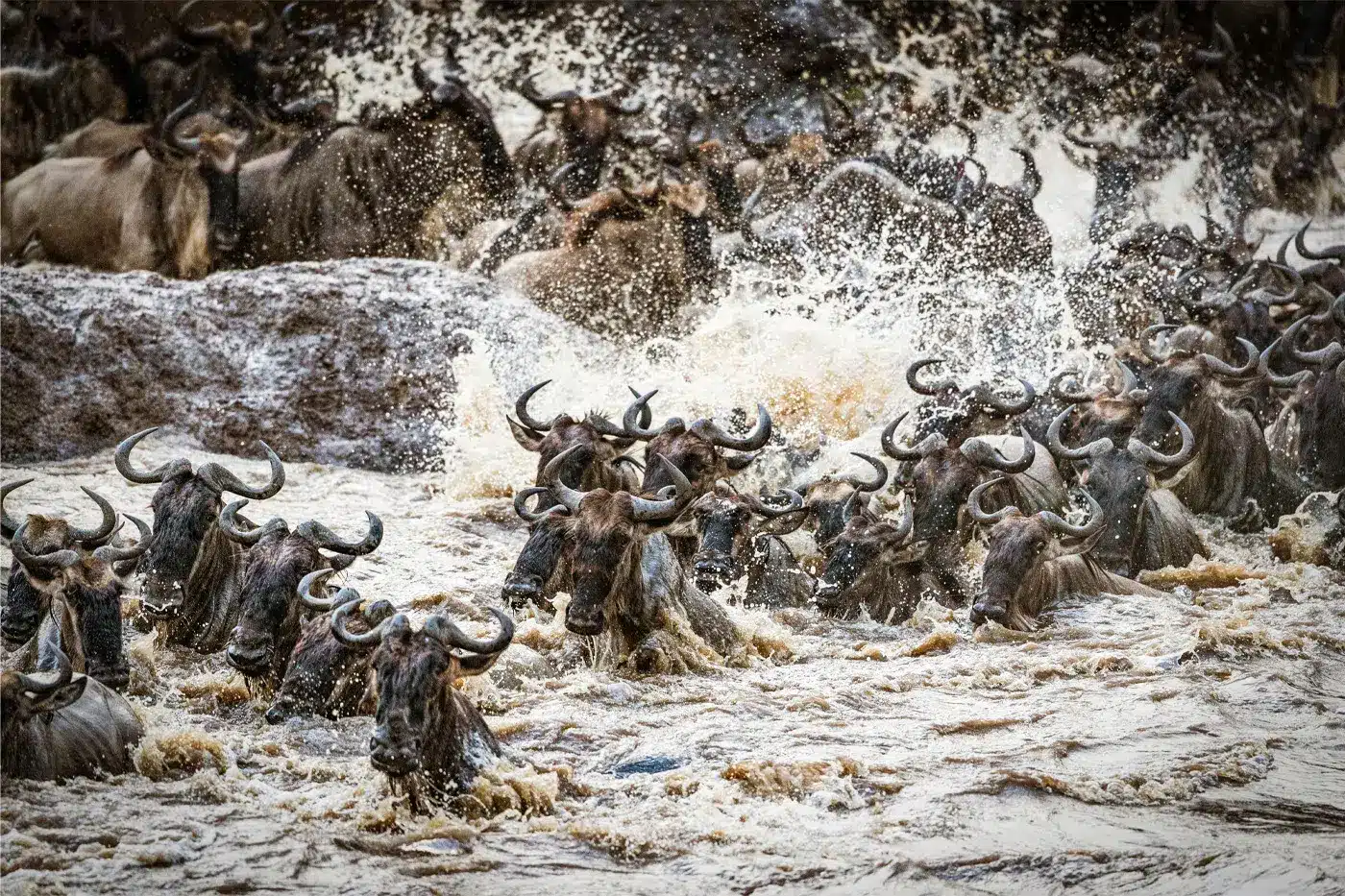
The end of June and the beginning of July will see the Grumeti River crossing, one of the most treacherous points in the migration’s passage. In order to move on to more hospitable grazing grounds, the Migratory Herd must cross the Grumeti River, teeming with crocodiles and watched on either end by predatory cats, waiting to pick off the slow movers.
Wildebeest Migration in August
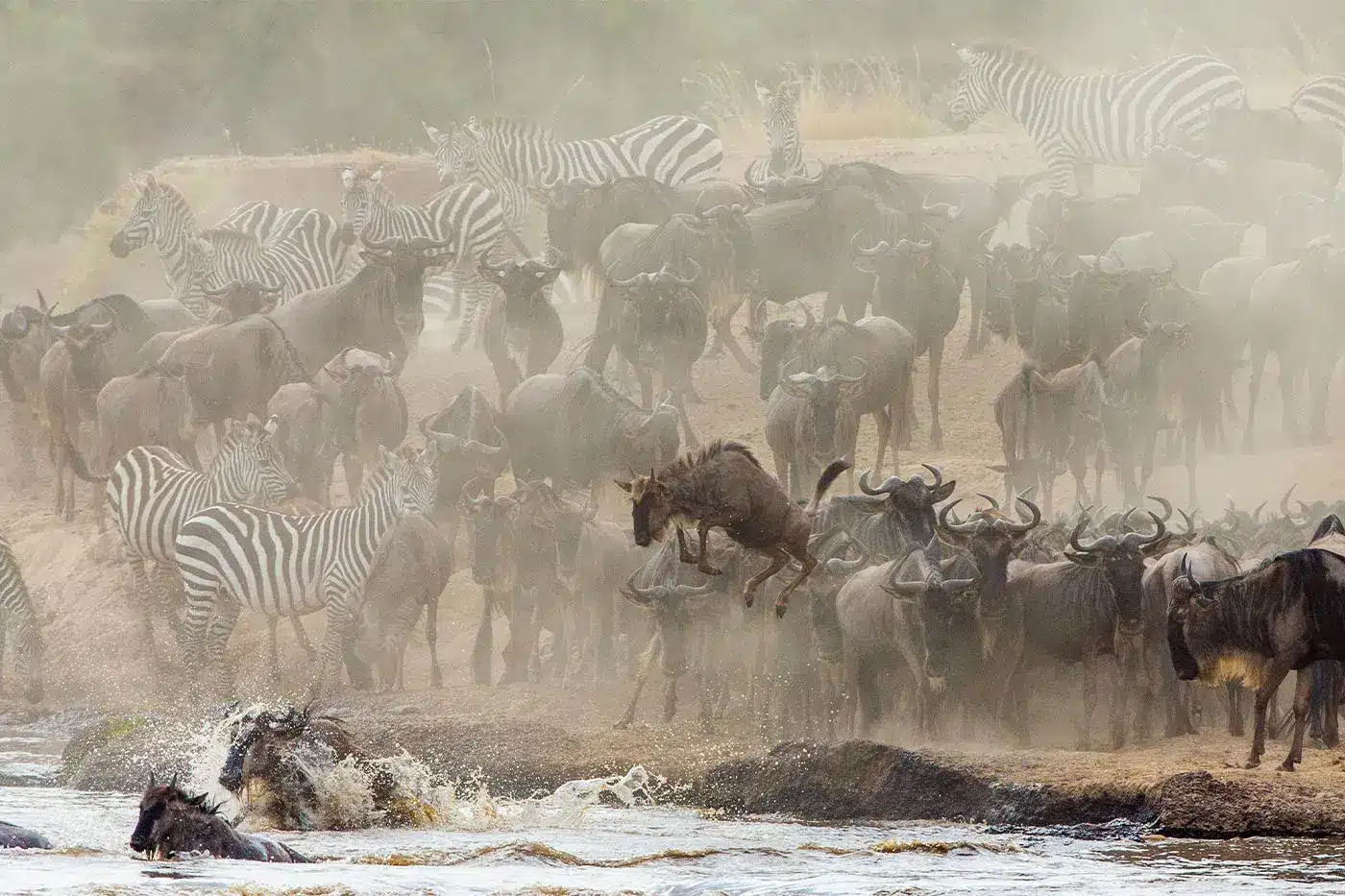
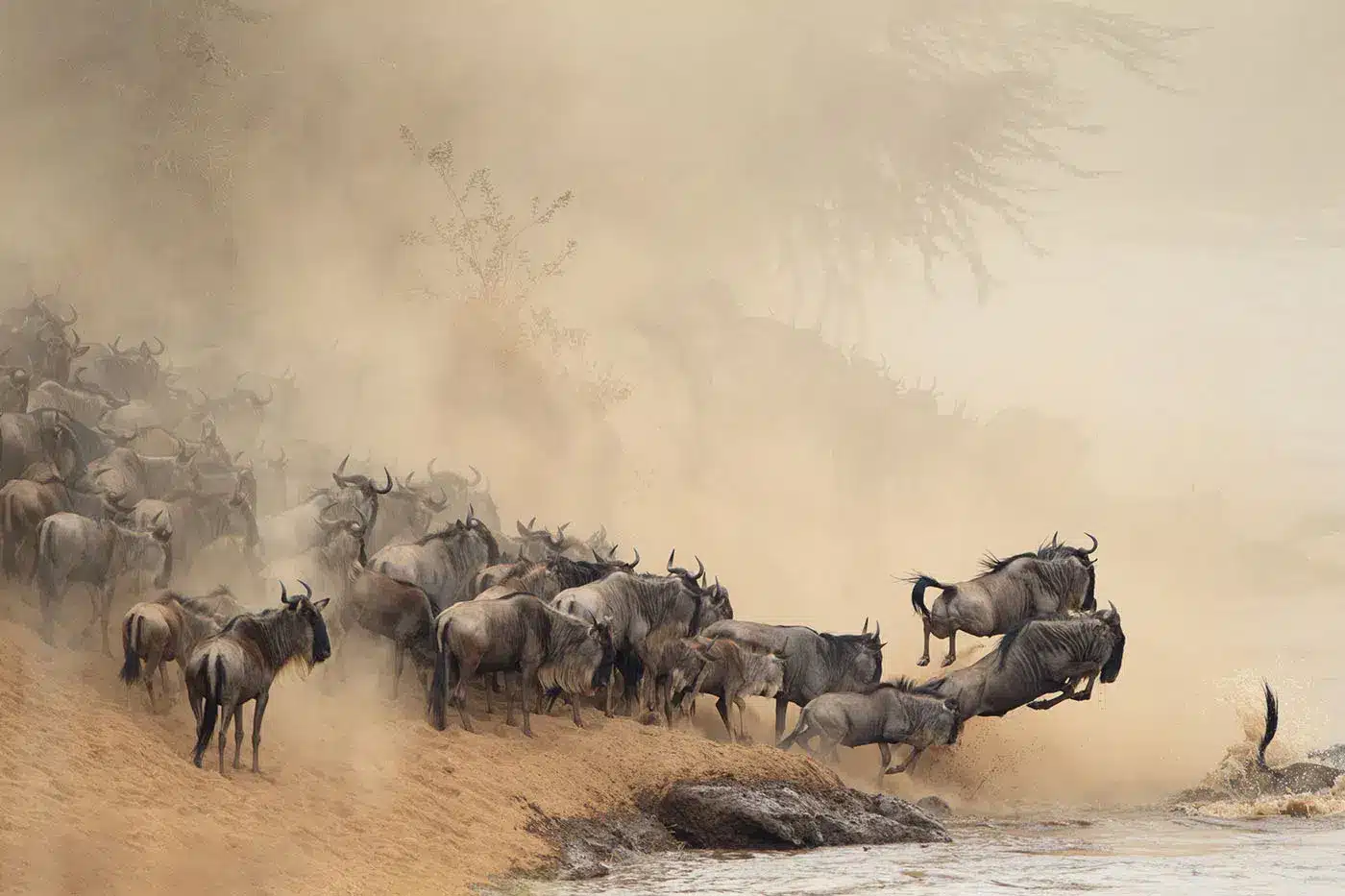
August is the height of the dry season, and the herd is moving as fast as it can northward, towards the relatively verdant reaches of Masai Mara in Kenya. Their path, though, takes them across another dangerous river crossing at this time, the Mara River. The Mara River crossing is one of the most incredible natural sights in the world: the high, churning waters, the eager crocodiles, the sleek cheetahs ready to pounce, and the millions of herbivores braving the perilous gauntlet.
Wildebeest Migration in September
The Mara River crossing is often a weeks-long endeavour. With the Great Migration in its unimaginable volume and the multiple dangers faced along the imposing Mara River, it comes as no surprise that this is a gargantuan effort for the herd to undertake. September will still see the Great Migration busy along the banks of the Mara River, moving slowly and ponderously from northern Tanzania into southern Kenya.
Wildebeest Migration in October
October will see the tail-end of the Mara River crossing, with most of the predators along its banks (or under its surface) happy from their hunting. While short rains will offer the herd a much-needed reprieve in terms of sustenance, they still have a short way to go until they can rest easy. October sees the end of the long dry season in Tanzania, meaning there are lots of animals densely packed into small areas.
Wildebeest Migration in November
With the perilous Mara River crossing nothing more than a bad memory for the herd, the Great Migration enters a period of relative calm as the short rain season begins in November. The herd doesn’t remain completely stationary and will begin moving out of southern Kenya and back into Ndutu and the Eastern Serengeti, where they will remain until March.
Wildebeest Migration in December
As the year closes, so too does the Great Migration. With their annual Migration coming as close as possible to a period of rest, the massive herd of millions of wildebeest can be seen grazing the open plains of Eastern Serengeti and Ndutu, readying themselves for the upcoming calving season and the dangers that await as the new year approaches.
WhatsApp us